Detours


As a pacifist and gay man, I find the focus of today's GLBT political community and the press on Don't-Ask-Don't-Tell (DADT) less than inspiring. While I understand the political importance of the issue to some, I dispute its merit as a major focus of the GLBT movement. The premise appears to be that being a soldier somehow makes a person, despite his/her sexual orientation, a more qualified or more respectable citizen. This is an unconstitutional premise in America.

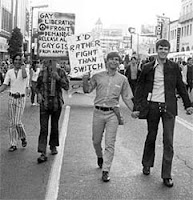
As a political movement, we rejected that premise resoundingly during the Gay Liberation Movement which existed quite healthily before being decimated by HIV. While many in the community of the late 1970s and early 1980s supported the personal struggle of Leonard Matlovich and others who were mistreated by the military, it was not a major focus of the movement. The main focus of the movement was to achieve direct and unqualified acceptance of all people under the law as equal in all rights of citizenship. Period.

DADT follows gay marriage as a wedge issue in Washington and in the media. The current GLBT leadership, Neo-Liberal at its best and Log Cabin at its worst, wants to make GLBT people 'just like straight people' under the law. This furthers the dichotomy of gay-vs-straight. It does not cut through the dichotomy to the core issue, universal human rights under the law. And, one of those universal human rights is the right to not be forced to kill or aid in the killing of another human being. As long as armies exist, so will conscription in one form or another.

The foundation of the modern GLBT movement rested on the peace movements of the late 1960s and early 1970s. Previous gay rights' organizations did not reach all classes and all segments of American society. They were primarily middle-to-upper-middle-class, intellectual organizations. The Stonewall Riot changed that, thanks to the courageous drag queens and working-class gay men who finally stood up to corrupt police oppression. Demonstration for equal human rights got the GLBT movement where it is today. Not back door legislation and political bargaining.

While I praise and support the GLBT people who strive for their rights in any way, I do not necessarily approve of their techniques. I would not approve of aggressive violence, for example. I do not approve of lobbying our way to freedom in a way that makes us look manipulative and aligned with everything that is wrong with government in the U.S., as it now operates.

I am also quite disgusted by the media's coverage of both the gay marriage and DADT issues. For example, today on NPR, I was presented with a back-and-forth discussion of the DADT issue by military-affiliated personnel, who freely spoke of GLBT people as though they were a different, non-human species. If the word "Jew" or "Black" or "Woman" were substituted in any of the statements made, there would have been enraged howls from all corners. Yet, the interviewers and presenters carried on with an air of everyday indifference.

DADT will not achieve universal human rights. Gay marriage will not achieve universal human rights. These battles, if won, will simply lessen the potency of the gay-straight dichotomy. And, in my opinion as a gay man and humanist, that simply isn't enough.

Uganda


As the Ugandan parliament wavers on passing a law to allow for the death penalty for gay men in that country and Uganda's executive still supports the 14-year jail sentence for being gay in Uganda, the Ugandans rejoice over the potential of massive oil revenues from the western part of that benighted country.

Ah, oil! Now it becomes glaringly obvious why no louder pressure is being put on Uganda by other governments, including the U.S. government, to avert the potential massacre of homosexuals in Uganda. It seems the new Africa-obsession includes good old homophobia and scapegoating, as long as those natural resources keep coming under the auspices of corrupted governments, propped up by international corporations.

Texting


I recently had an experience which baffled me. An old friend posted a comment on my first essay for The New Humanism, a journal of the Harvard Humanist Chaplaincy. She was good enough to email me to alert me to her dissatisfaction with the comment on retrospection. When I read the comment, I was stunned. It didn't read at all like her, as I have known her for about 25 yrs..

The comment has been removed with her consent. I have processed my initial feelings of disappointment and anger at the glibness of the comment in the context of a journal, which I highly respect as a serious forum for Humanism. The whole experience has made me think quite a bit.

It seems we are all becoming sloppy with our speech in print. That is, with texting and Facebook-ing day in and day out, our communication is becoming too immediate and uninhibited in general. This is one of very few situations which have effected me in this way, but I hear stories quite regularly in media about cyber-bullying and bad communication in new media. More contact, less quality. I feel the pull of it, the challenge to be who I am with one line.

My own style of writing is frequently criticized in on line situations. I have been told I am too formal, too stuffy, cold, too intellectual, too uptight, etc.. I have stopped frequenting chatroom situations because of this and have no intention of embracing Twitter.

There are reasons why I write as I do. I began my schooling with severe dyslexia in a Roman Catholic school in 1955, when Catholic nuns saw dyslexia as a sign of the devil. I spent many hours crying in a closed coat closet at the back of my first grade classroom. This unintentionally Skinnerian method scared me into reading from left to right eventually. I learned to slow down and ignore the mockery of my classmates as I picked through the words through restrained sobs.

Later on, I had two pen pals. One in Australia and one in France. They were wonderfully encouraging tutors. The girl in Australia, who planned to be a nurse, gave me my first compliment as a writer. She wrote that she waited every week for my letters and saved them to read at night before she went to sleep. My French correspondent, who wrote to me to learn English, gave me confidence by allowing me to explain English idioms to him and coach his study of my language. Since I was useless at French, this was a true gift: I learned that I could communicate intelligently with someone in another culture without having to be discouraged by my deficiency in their language.

My pre-medical course in college was grueling for me. It was a bad fit, but my parents urged me on for their sake. In my sophomore year, I desperately wanted to be an English Literature major. I was immature and seventeen. I allowed myself to be talked out of it by my parents. My English Literature professor at the time became quite upset and ignored me for the rest of the time I was at that campus. In a strange way, I took his anger as a compliment.

The years have given birth to a series of personal journals with diary entries, poetry and short stories. I am a writer. I have been since an early age, but I have only been able to say that I am a writer with confidence for the last several years.

Now I find writing is becoming casual speech, and casual speech is corrupting writing, in my opinion.

I know I am definitely not the first 60-year-old who has felt like a stranger on a strange planet. But, I am not happy or comfortable feeling that way. I want to be in tempo with the Zeitgeist. I try to maintain an interest in expanding and changing technologies.

I guess I have found a boundary which I do not wish to cross. 'It's all good' has never been my slogan, because it isn't all good. Some of it is pretty awful. I will continue practicing considered, honest and mindful speech to the best of my ability. Whether by mouth or by keyboard. It is who I want to be and who I continue to try to become.