Showing posts with label universal human rights. Show all posts

Entitlement


An entitlement is a just claim or right, usually granted by some authority to an individual. Entitlement may also refer to a personal attitude. This usage is common in therapeutic circles.

The attitude of entitlement is seen as an unconscious, narcissistic sense of being owed a certain deference without any rational basis for that belief. It is often a defense against self-loathing, but it can be the result of poor socialization or poor parenting. Part of healthy human development is the achievement of an understanding of the basic worth and commonality of all human beings. Added to that understanding, a rational, socialized human being realizes that respect and consideration are earned by respectful behavior and responsible action. The entitled person, in the psychotherapeutic sense, enters human interactions and social situations with a demanding or emotionally needy attitude which has no real or socially accepted basis in objective reality.

In the current American political landscape, legal entitlements, such as social security and unemployment benefits, are decried by The Right as frivolous waste of public funds. Their adamant railing against these social benefits imply that the recipients are milking the public treasury unnecessarily and unjustly. Ironically, this reflects an attitudinal entitlement in the holders of these views, who are often fortunate to be wealthy enough, while holding these opinions, to not need the benefits themselves. They feel entitled to live in a safe and comfortable society without paying for the social infrastructure that creates the conditions they obviously take for granted.

The iPhone and Blackberry seem to enforce this sense of general impatience and entitlement. Mesmerized by the power of a portable, compliant slave, which offers up demanded information with the flick of a thumb or finger, people could tend to be less patient with human servers and coworkers, whose clocking times tend to be less immediate and require a certain amount of social prompting to get the best result. Having slaves of any kind, historically, has bred the worst form of entitlement in their masters.

The culture of "we are all special" has contributed to entitlement in many who are not special and who are perhaps are not even average. This is the entitlement of the bling-encrusted felon, now a rapper, whose knowledge or understanding of the human condition is minimal. However, this individual strides from talk show to talk show and dispenses the wisdom of the ignorant with great hubris. The echo effect of this media barrage breeds entitlement in similar listeners, who feel themselves ordained by their rough-shod role model.

The pathological attitude of entitlement, in my opinion, is a reflection of the inequality and lack of education in society. I believe the most basic human entitlement, in a legal or ethical sense, is the birthright to a safe, well-nourished, properly housed, maximally educated and justly employed life span from cradle to grave. Who would be responsible for granting this birthright or entitlement? The state? No. I believe it is the responsibility of every person who brings a child into this world to provide this basic birthright to each and every child.

"It takes a village to raise a child!" I hear the frequent refrain. Yes, I agree. Just as no one of us has the ability to build a television set, a car or an iPhone, no one person has all the tools to provide that basic birthright to a child from cradle to grave. However, this does not excuse propagating the mindless reproduction by those who have absolutely none of the tools to provide that basic human birthright. Nor does it justify Tea Party or Libertarian rantings about denying any social benefits paid for by tax money.

The best treatment for pathological entitlement is the provision of the basic legal entitlement of universal rights to a quality lifespan to each and every human being who is born. This cannot be attended to exclusively with legislation or religious doctrine. Experiments in enforcing these ideals from the top down have failed miserably. This must come from educated and properly socialized individuals who decide to procreate and participate in a just society. The way to that ideal is not every-man-for-himself, the populist battle cry in America, covertly funded by corporate dollars.

The current humanist movement for universal human rights worldwide is an important first step to providing the most basic human justice for all human beings on the planet. Until all human beings are entitled to a quality life from cradle to grave, the plagues of war, greed and injustice will flourish.

Culture


The current infatuation with multiple cultures in America seems enlightened on the surface. However, it is important to bear in mind that cultures often stand in the way of greater human progress. Idolizing a culture without a critical and analytical eye is childishly naive.

I was aghast yesterday as I listened to an NPR quiz show. The guest celebrity was a rap singer who was overtly and unabashedly bragging about his American subculture of violence, robbery and drug abuse. The audience seemed to find this quite humorous. I found it disturbing and symptomatic of a sick society.

Similarly, the recent fascination in America with Islamic cultures seems a natural reaction to being aggressively attacked on September 11th, 2001 by a wealthy Saudi madman and his minions. However, the equivocation of cultures which behead women for adultery and hang young men for being gay to American culture is just plain stupid. Many Americans seem unable to take the critical step to investigate a culture's full spectrum of positive and negative traits. I speculate that this is based in intellectual laziness or a delusion that smiling at everything about a culture will keep people from that culture from creating mayhem.

Human cultural development follows patterns which can be readily discerned by studying history critically and analytically. This implies the use of science, a foreign culture indeed for many contemporary Americans, it seems. Science isn't about being blissfully ignorant. It isn't about denying the unpleasant in hopes that it will go away.

Multiculturalism in America can serve a wonderful purpose to enrich the greater American culture. However, the present approach media and politicians are taking toward multiculturalism is shallow and inane, generally. Blanket acceptance of any culture as "great" or "cool" is counterproductive. Fostering the elements of any culture which advance universal human rights and world peace is common sense. Learning the difference takes time, study and openness to truth.

Universal


Universal human rights would be the same civil rights for every human being, no matter how they look or what they believe or whom they love or where they were born. Everyone, everywhere.

This requires a change in human perception. Rather than granting people respect based on their looks or how they sound, it requires granting all people the same respect on first look. This challenges an instinctual human tendency to classify. It is a survival instinct. Is this object safe or dangerous? Life experience shapes the form this instinct takes as people age. Education, ignorance, love or trauma can shape this instinct, for functional good or dysfunction.

For people old enough to have been shaped by life, learning to disregard the tendency to classify people as safe (good) or unsafe (bad), based on very superficial criteria, is nearly impossible. It requires tremendous practice and mindfulness. And, even then, the mind reverts to old habits easily.

Meditation in Buddhism is a tool to overcome the dysfunctional mind, the cluttered mind. As a humanist, I find meditation helpful. However, I find that I have been able to develop my own little instant-replay system. As I go through my day, I evaluate my responses to people and my interactions with them. I try to keep that more objective consciousness running, like a surveillance camera, which I can replay after an interaction or an experience.

I have learned a great deal from this practice. I have been able to use some of what I have learned for the better in my life. I have also learned how deeply judgmental and prejudiced I tend to be towards people. Decades of dyed-in-the-wool habits, which are exhaustively relentless, just under my conscious mind.

Prejudice is simply stupid. Judgment is not in itself a bad thing. As a nurse in an acute psychiatric ward, I was paid for my preformed understanding of certain dysfunctional behaviors. I was also paid to make professional judgments about dealing with these behaviors to avoid violence or unnecessary pain. I want an experience cop around if I am in a dangerous situation. His informed classification of a behavior, based on training and experience, could lead to a judgment which could save my life.

Universal judgments about racial, ethnic or sexual groups are counterproductive and unsafe. They lead to violence, war and social regression. Perhaps the current political correctness of certain social classes and arenas is a good form of behavioral therapy for nonconstructive prejudices and judgments. However, the tendency of the politically correct to condemn all judgment, even when based on experience and knowledge, as bad or wrong is simply stupid, in my opinion.

My practice as a humanist is to promote universal human rights in any way I can. I see this as a process that occurs with one situation or relationship at a time. I think the political advocacy of specific special-interest groups in the American political system is currently an anachronistic method to achieve universal human rights. I feel the process is in itself divisive. I would prefer to see all groups who feel disenfranchised joined in a universal human rights coalition, which could approach government and demand comprehensive legislation on human rights for everyone in society.

Pluralism


---a social organization in which diversity of racial or religious or ethnic or cultural groups is tolerated
---the doctrine that reality consists of several basic substances or elements
---the practice of one person holding more than one benefice at a time

The current political and social climate in the U.S. is fraught with contention and polarity. The concept of bipartisanship in Congress is spoken of as a mythical Holy Grail. Social issues of gay-vs-straight marriage, religious-vs-atheist thought, color-vs-white racialism, native-vs-immigrant citizenship threaten to mire progress for all on any social or economic problems.

Pluralism, as defined above, is seen by some as a remedy for this dichotomy-based quagmire. In other words, "Can't we all just get along?" I tend to agree, to a point. My ongoing question is this: When does pluralism blur into moral/ethical equivocation, as definition below? This is the inherent challenge of pluralism, in my opinion.

---evasion: a statement that is not literally false but that cleverly avoids an unpleasant truth
---intentionally vague or ambiguous

source:wordnetweb.princeton.edu/perl/webwn

So, it is my practice to carefully gauge pluralist rhetoric against a standard of universal human rights and global peace. For example, while I do not feel it is my place to determine whether or not an adult woman wears a head scarf or a nose ring, I do feel it is my responsibility to stand against these symbols when they mask misogyny and the abuse of women's rights of choice over their own bodies. In other words, while accepted as cultural markers, they must also be open to frank inquiry and discussion in a free pluralistic society.

Pluralism has been used in Neo-Liberal circles as a leveling method to create a Big Tent for progressive political movement. But, the Neo-Liberal line often drifts into equivocation as a way to avoid political dissension in the ranks. This sabotages its own effectiveness as a political philosophy. The free market in Reaganite capitalism often thrives on the abuse of social responsibility and individual rights, for example. This is at the core of the current unpopularity of the Obama administration's Neo-Liberal approach to the financial capitalists who have brought on the current economic collapse.

Progress means change. Change often necessitates choosing between those things which are functional and just over those things which are not. Stagnant pluralism can be a drag on change for this simple reason. Pluralism, to be effective at promoting human rights and global peace, must also be dynamic, ever evolving, always examined. This is very hard work, but it can be less bloody and more effective at getting us to where our core human values guide us.

Detours


As a pacifist and gay man, I find the focus of today's GLBT political community and the press on Don't-Ask-Don't-Tell (DADT) less than inspiring. While I understand the political importance of the issue to some, I dispute its merit as a major focus of the GLBT movement. The premise appears to be that being a soldier somehow makes a person, despite his/her sexual orientation, a more qualified or more respectable citizen. This is an unconstitutional premise in America.

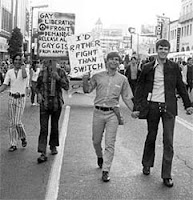
As a political movement, we rejected that premise resoundingly during the Gay Liberation Movement which existed quite healthily before being decimated by HIV. While many in the community of the late 1970s and early 1980s supported the personal struggle of Leonard Matlovich and others who were mistreated by the military, it was not a major focus of the movement. The main focus of the movement was to achieve direct and unqualified acceptance of all people under the law as equal in all rights of citizenship. Period.

DADT follows gay marriage as a wedge issue in Washington and in the media. The current GLBT leadership, Neo-Liberal at its best and Log Cabin at its worst, wants to make GLBT people 'just like straight people' under the law. This furthers the dichotomy of gay-vs-straight. It does not cut through the dichotomy to the core issue, universal human rights under the law. And, one of those universal human rights is the right to not be forced to kill or aid in the killing of another human being. As long as armies exist, so will conscription in one form or another.

The foundation of the modern GLBT movement rested on the peace movements of the late 1960s and early 1970s. Previous gay rights' organizations did not reach all classes and all segments of American society. They were primarily middle-to-upper-middle-class, intellectual organizations. The Stonewall Riot changed that, thanks to the courageous drag queens and working-class gay men who finally stood up to corrupt police oppression. Demonstration for equal human rights got the GLBT movement where it is today. Not back door legislation and political bargaining.

While I praise and support the GLBT people who strive for their rights in any way, I do not necessarily approve of their techniques. I would not approve of aggressive violence, for example. I do not approve of lobbying our way to freedom in a way that makes us look manipulative and aligned with everything that is wrong with government in the U.S., as it now operates.

I am also quite disgusted by the media's coverage of both the gay marriage and DADT issues. For example, today on NPR, I was presented with a back-and-forth discussion of the DADT issue by military-affiliated personnel, who freely spoke of GLBT people as though they were a different, non-human species. If the word "Jew" or "Black" or "Woman" were substituted in any of the statements made, there would have been enraged howls from all corners. Yet, the interviewers and presenters carried on with an air of everyday indifference.

DADT will not achieve universal human rights. Gay marriage will not achieve universal human rights. These battles, if won, will simply lessen the potency of the gay-straight dichotomy. And, in my opinion as a gay man and humanist, that simply isn't enough.